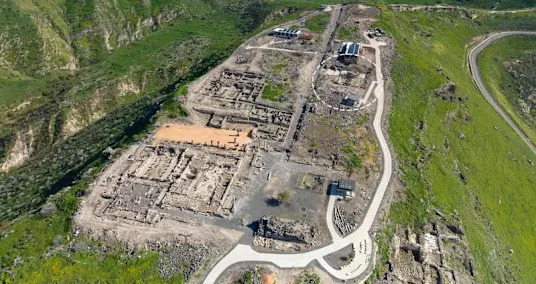
Additional discoveries made a the site included a bronze candelabrum and marble reliquary, both the largest of their kind to ever be found in Israel.
A marble block with three half-sphere depressions was found beside a baptismal font, thought to possibly point to a lost stage of early Christian baptismal rites, was found in the ancient city of Hippos, not far from the Kinneret, according to a recent study.
The artifact, unlike anything previously documented in archaeological record, was discovered during excavations focused on a newly unearthed ceremonial hall annexed to the south of Hippos’s cathedral. Inside, archaeologists found a partially preserved room housing a baptismal font and several other liturgical objects.
“Only after careful research did we realize how unique they are for understanding Christian ritual practices in the cradle of Christianity by the Sea of Galilee,” said Dr. Michael Eisenberg of the Zinman Institute of Archaeology and Haifa University, one of the leaders of the excavation.
Currently, researchers' leading theory regarding the artifact’s use is that it was meant to hold three different oils used during the threefold baptismal immersion ceremony, rather than the two anointings in the pre- and post-baptism.
Evidence further suggests that the ceremonial hall was constructed after 591 CE and later destroyed during an earthquake in 749 CE, which buried the artifacts beneath heavy rubble leading to their preservation.

Additional discoveries made a the site included a bronze candelabrum and marble reliquary, both the largest of their kind to ever be found in Israel.
Ancient Hippos: Only Christian Byzantine city on the Kinneret
Hippos was the only Christian city around the Kinneret during the Byzantine age, controlling a broad swath of territory including the southern Golan and the Kinneret’s eastern shore, an area Christian tradition associates with the ministry of Jesus.
As such, the cathedral of Hippos, one of approximately seven churches to have operated within the city at the time, became the most prominent ecclesiastical place of worship in the region.
It is also the only known church to have had two designated halls, or photisterion (“hall of illumination”), with baptismal fonts. The photisterion previously excavated at the site is the largest known among Byzantine churches in Israel.
According to researchers, the larger hall was used primarily for adult baptisms, while the second, recently discovered hall was used for the baptisms of infants and children.
“Baptism was one of the central rites of Christian communal life and gradually took shape during the Byzantine period,” Eisenberg concluded. “In different regions, distinct liturgical traditions developed, many of which are not documented in written sources.”
“This find offers a rare glimpse into how the baptismal rite was shaped and practiced in the Byzantine Christian community of Hippos.”
The complete findings were published by Dr. Michael Eisenberg and Dr. Arleta Kowalewska in an early March edition of the Palestine Exploration Quarterly.
LATEST POSTS
- 1
 Air India chief resigns 10 months after devastating Ahmedabad crash and amid mounting financial troubles
- 2Step by step instructions to Boost the Eco-friendliness of Your Smash 1500.
- 3ABC News' Sam Champion opens up about recent health scare
- 4NASA's Voyager 1 set to achieve historic distance from Earth
- 5Under pressure at home, Belgium's leader treads a tight rope with EU partners over funds for Ukraine




- Reporter's Notebook: The Post embeds with foreign armies visiting the IDF
- Sound Maturing: Wellbeing Tips for Each Life Stage
- What causes RFK Jr.’s strained and shaky voice? A neurologist explains this little-known disorder
- The Job of Attorneys: It is Important to Comprehend When Legitimate Help
- Geminid meteor shower 2025 peaks next week. Here's what you need to know about this year's best meteor shower
- 5 Family SUVs for 2024: Which One Accommodates Your Family's Needs\uff1f
- Simple Consideration Plants for Home and Office: An Aide
- Promising Speculation Bearings for Portfolio Development in 2024
- Chinese construction workers in Israel: 'I’d rather be bombed than live in poverty'