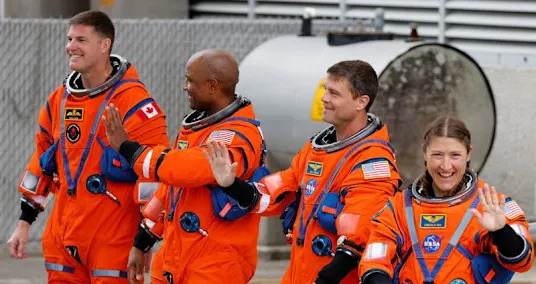
April 1 (Reuters) - All three NASA astronauts on the Artemis II lunar mission are veterans of Earth-orbit science expeditions to the International Space Station, while the lone Canadian joining them on a voyage around the moon and back is a spaceflight rookie.
Here are some highlights from the careers of mission commander Reid Wiseman, pilot Victor Glover and mission specialist Christina Koch, all U.S. astronauts, and Canadian astronaut Jeremy Hansen, also a mission specialist.
MISSION COMMANDER REID WISEMAN
Wiseman, 50, logged 165 days aboard the International Space Station during a 2014 mission, flying to the orbiting platform aboard a Russian Soyuz spacecraft. A former U.S. Navy test pilot, he later served as NASA's chief astronaut before being selected to command Artemis II.
PILOT VICTOR GLOVER
Glover, 49, spent 168 days in orbit beginning in 2020 as pilot of NASA's Crew-1 flight, the first full-fledged ISS mission using SpaceX's Crew Dragon capsule to carry astronauts to the space station. Before joining NASA, he flew more than 40 aircraft during a U.S. Navy career that included combat deployments and test-pilot duties. A veteran of four spacewalks, he is the first Black astronaut ever to be sent on a lunar mission.
MISSION SPECIALIST CHRISTINA KOCH
Koch, 47, set a record in 2019 for the longest continuous spaceflight by a woman, spending 328 days aboard the ISS, and was part of NASA's first three all-female spacewalks. Trained as an electrical engineer and physicist, she previously worked as a NASA engineer and carried out extended research expeditions in Antarctica. She is the first woman to fly on a moon-bound mission.
MISSION SPECIALIST JEREMY HANSEN
Hansen, 50, a Royal Canadian Air Force colonel, is the first Canadian, and first non-U.S. citizen, sent on a lunar mission even as he makes his own first spaceflight. He was selected for Canada's astronaut corps in 2009, and his seat aboard Artemis II reflects a long-standing U.S.–Canadian partnership in human spaceflight, including Canada's contributions to robotics used aboard the ISS.
(Compiled by Joey Roulette in Cape Canaveral, Florida and Steve Gorman in Los Angeles; Editing by Jamie Freed)
LATEST POSTS
- 1
 Find Your Internal Culinary expert: Cooking Strategies and Recipes
 - 2Watch China's Shenzhou 22 rescue ship arrive at Tiangong space station (video)
- 3Mosquitoes carrying malaria are evolving more quickly than insecticides can kill them – researchers pinpoint how
- 4He made a name for himself posting thirst traps on TikTok. Now he's the star of a wildly popular rom-com.
- 5Czech Republic caps fuel prices amid Iran war energy crisis





- Going on a bad date is a drag. Worse? Ending up as a cautionary tale on TikTok.
- Geminid shooting stars: One of 2025's most exciting meteor showers begins tonight
- Real time features for Films and Programs
- Medtronic has 'significant firepower' for multiple acquisitions, executives say
- Palestinians forced from West Bank refugee camps left in limbo as Israeli demolitions go on
- Iran plans new restrictions in overhaul of Strait of Hormuz rules
- A Pompeii site reveals the recipe for Roman concrete. It contradicts a famous architect’s writings
- Volkswagen Plant Could Pivot From Building Cars to Supporting Iron Dome Systems
- Most loved Road Food: Which One Prevails upon You?